

Poseidonpartiet
Pontos
- Party credibility
- 500/1000
- Change this term
- −30
- Campaign promises
- 1
Futuregames · Game psychology · September 2026
What happens when politicians have a score to protect?
A gamification project about political promises, public trust, and the incentives hiding inside a leaderboard. Our four-person team built the product. I built the political sandbox behind it.
Simulation design & orchestration · Product development · Motion design
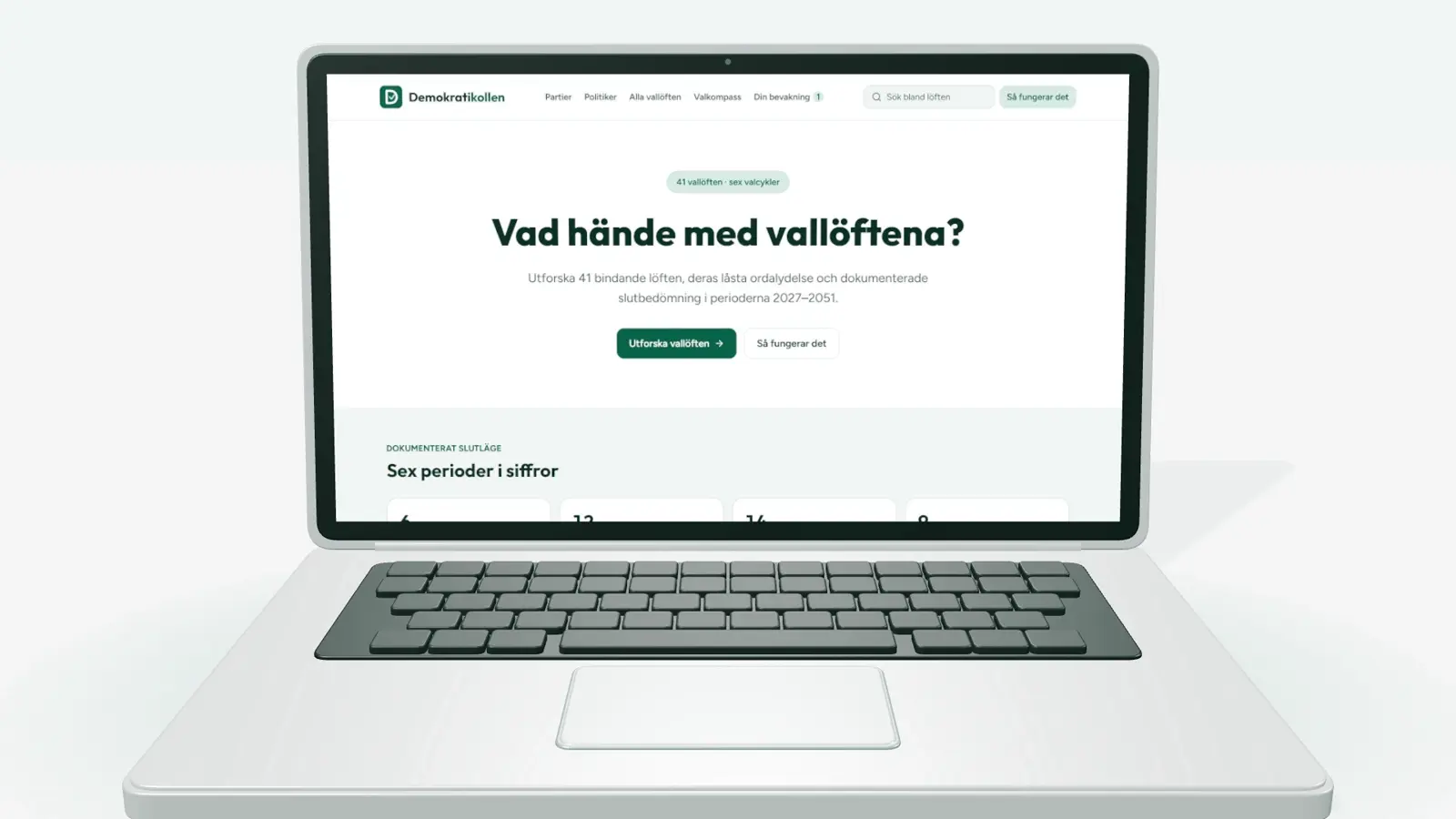
From promise to outcome
Demokratikollen makes campaign promises easier to follow. Visitors can compare parties, inspect the evidence behind a promise, save what matters to them, and explore a voting compass. Credibility scores and visible outcomes turn a dense political record into something you can return to and understand.
Gamification here means feedback, consequences, and a reason to keep following—not rewards with a real-world monetary value.
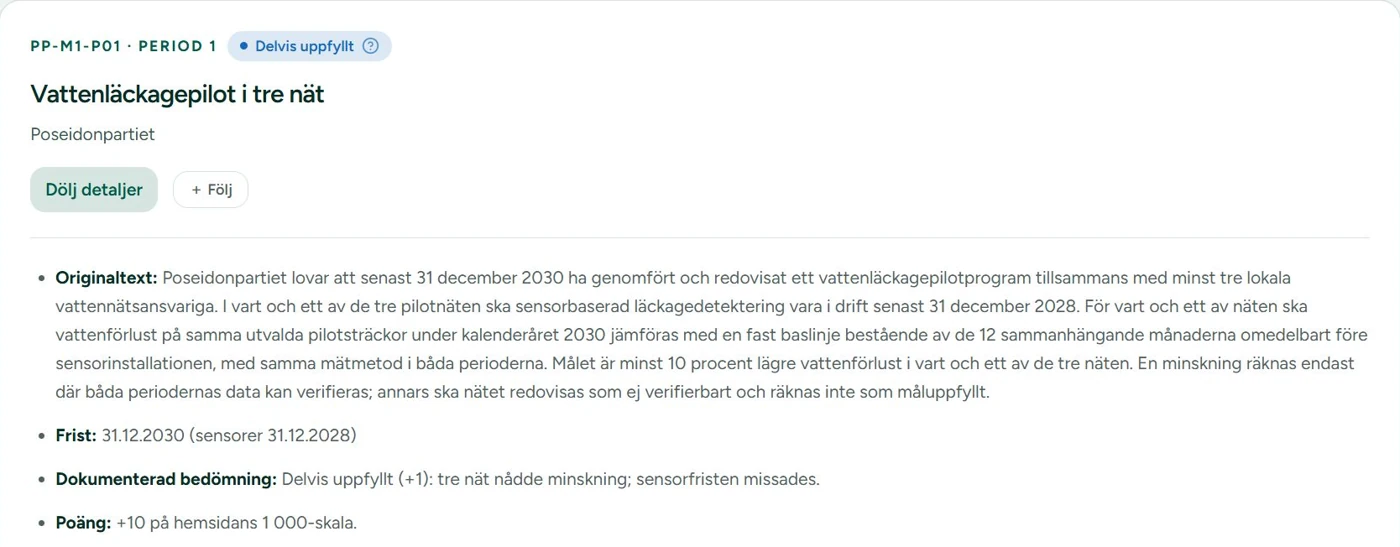
The feedback loop I tested
My simulation studio
I set up five separate AI party chats and a neutral coordinator, then designed and ran campaigns, elections, and compressed terms in office. I shaped the scoring rules, used a seeded Python voting model for repeatable comparisons, and kept promises and outcomes traceable in the logs. Rather than script winners, I followed how the parties responded to their own results.
Pontos


Timon


Roger Rimlig


Itchy


Steg-fan Framåt
Six promises, mixed results. Allergipartiet delivered its promise; Hakuna Matata partly delivered. Framkomlighetspartiet could not substantiate either of its two promises and lost 60 points.
After term 4. 6 promises made this term. Six promises, mixed results. Allergipartiet delivered its promise; Hakuna Matata partly delivered. Framkomlighetspartiet could not substantiate either of its two promises and lost 60 points.
Scores show promise follow-through, not popularity or political merit. A party without the power to deliver a promise was not penalized for that lack of power.
The revealing moment
After missed deliveries, Framkomlighetspartiet moved from two promises to one, then none. The agents became more cautious. That was also a design warning: a score intended to reward accountability can encourage avoiding commitments altogether.
Observed AI behavior inside this model—not evidence of how real politicians or voters would behave.
FRAMKOMLIGHETSPARTIET
What changed along the way
Long coalition negotiations were crowding out the experiment. I redirected it toward measurable promises, limited resources, and evidence at the deadline. Choosing the number of promises became a strategic decision.
I integrated the actual simulation data, improved the voting-compass flow and promise explanations, and produced the launch film with AI-assisted motion design. The interface became a way to explore the experiment.
Two human usability tests run by teammates exposed confusing scores, statuses, and overly positive badges. I addressed feedback with clearer progress, help text, and factual status summaries. These tests examined usability; the AI runs examined incentives.
Team project with Linnéa Hedblom, Anna Malmgren, and Pontus Joelsson. The initial website, visual assets, and human testing were shared team contributions; my focus was the simulation, integration, iteration, and launch film.