Local experiment
Tab Cleanup
Per-server cleanup for rank prefixes, icons and formatting, with a live before-and-after preview.
Fabric client mods · June—July 2026
A deliberately bounded shipping lab: notice one recurring annoyance, solve it cleanly, and put it in front of real players.
The loop
Most ideas came directly from playing Minecraft or listening to a community request—not from searching for a large feature list.
Stay with the game long enough to feel the rough edges.
Reduce one repeated annoyance to a narrow problem.
Build, test and publish; then learn from real use.
Two deeper builds
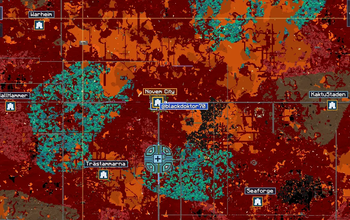

Community tool · maps and resilient data
PublishedBrings a public SMP map into Minecraft with Overworld, Nether and End views, live players, markers, search and favourites—without requiring a server mod.
Open on Modrinth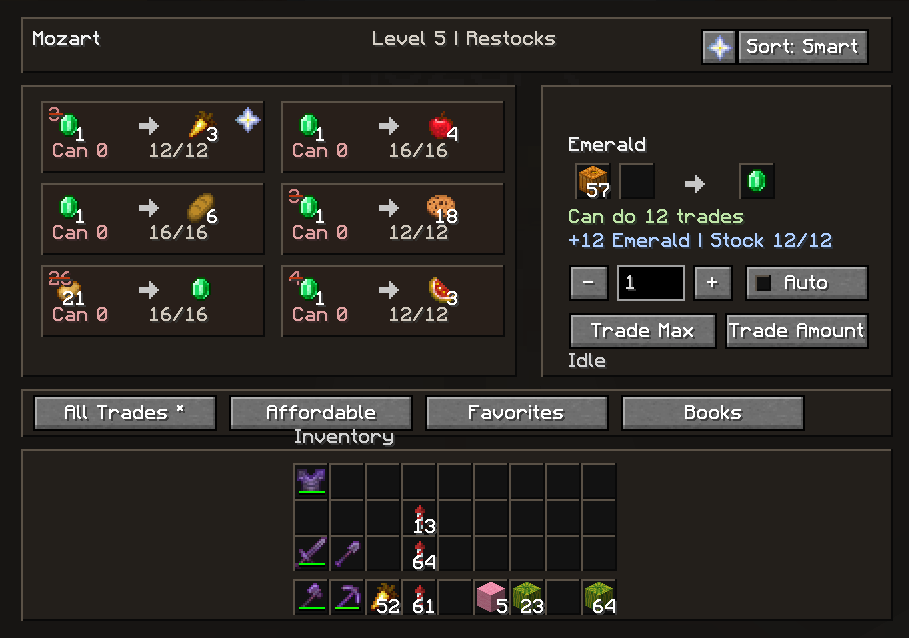
Interaction design · faster, safer trading
PublishedReplaces the narrow merchant list with a searchable grid, sorting, favourites and conservative bulk actions built on the real trade slots.
Open on ModrinthThe toolkit
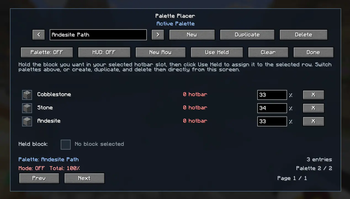
Building utility
Weighted block palettes switch between matching hotbar blocks while you build.
Open on Modrinth
Visual multiplayer tool
Renders a worn filled map as the player’s face, with optional Paper sync for multiplayer.
Open on Modrinth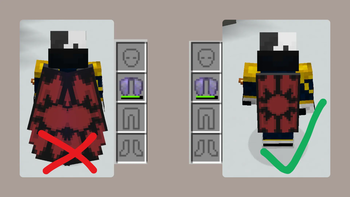
Cosmetic toggle
Keeps a cape visible over an elytra, always or only while the player is not flying.
Open on Modrinth
Information HUD
A compact, filterable list of nearby entity icons and live counts.
Open on ModrinthLocal experiment
Per-server cleanup for rank prefixes, icons and formatting, with a live before-and-after preview.
Local experiment
A tunable procedural oak generator—and a reminder that variation still needs human taste.
The deliberate stop
Ports, compatibility work and storefront visibility quickly became their own loop. In July I capped the lab before it displaced Block By Block Tycoon—the project it was meant to refresh me for.
All projects