
All projects

    Unity 20th Anniversary Game Jam · November 2025

    Painter’s Legacy

    A small atmospheric painting game made for a jam framed around 48 hours, with roughly 25–30 usable personal hours. Paint through youth, adulthood, and old age—then discover where the work ends up.

    Created solo by Elmer Almer Ershagen and released under Evion Studios.

    48-hour game jam storyUnity · C#2025

    Jam premise

    48h

    the challenge’s public framing

    Usable window

    ≈25–30h

    personal time available across the weekend

    Structure

    3 stages

    youth, adulthood, and old age

    Submission

    5h 01m

    before the official deadline

    The idea worth keeping

    Timeless was not a mechanic. It was a legacy.

    “Timeless” could have meant stopping, rewinding, or racing time. The project instead asked what makes a creation outlive its maker. That interpretation reduced a broad theme to one person, one room, and three paintings made across a lifetime.

    One room changes through three stages of life instead of becoming three separate levels.

    The build, against the clock

    From a blank canvas to a submitted game

    The jam was framed around 48 hours. Real life left roughly 25–30 usable hours across the weekend, so every chapter became a choice about what the game truly needed.

    The jam premise

    A whole game in one weekend

    48:00:00

    1. 48:00:00

      The jam premise

      A whole game in one weekend

      The Unity 20th Anniversary Game Jam framed the challenge simply: start from the theme and make a finished game in one 48-hour weekend. The goal was not a large production. It was to rediscover the pleasure of making a small game from beginning to end.

      • One solo developer
      • A fresh Unity project
      • A playable submission before the deadline
    2. ≈25–30h

      The time actually available

      The clock had already lost hours

      Large parts of Saturday and Sunday were already committed, leaving only about 25–30 personal hours—not 48 uninterrupted development hours. That removed the safety net: a half-day detour could mean no game at all.

      • The schedule could not move around the jam
      • The project needed one clear direction
      • Anything non-essential had to earn its place
    3. TIMELESS

      The theme reveal

      Interpret time as legacy

      Instead of building another rewind, pause, or time-loop mechanic, the concept followed a different meaning of “timeless”: the things people create that remain after they are gone. A painter moving through life made that idea playable without requiring a sprawling story.

      • One theme: Timeless
      • One character: a painter
      • One question: what remains?
    4. FIRST MARK

      The first mechanic

      Make painting work before anything else

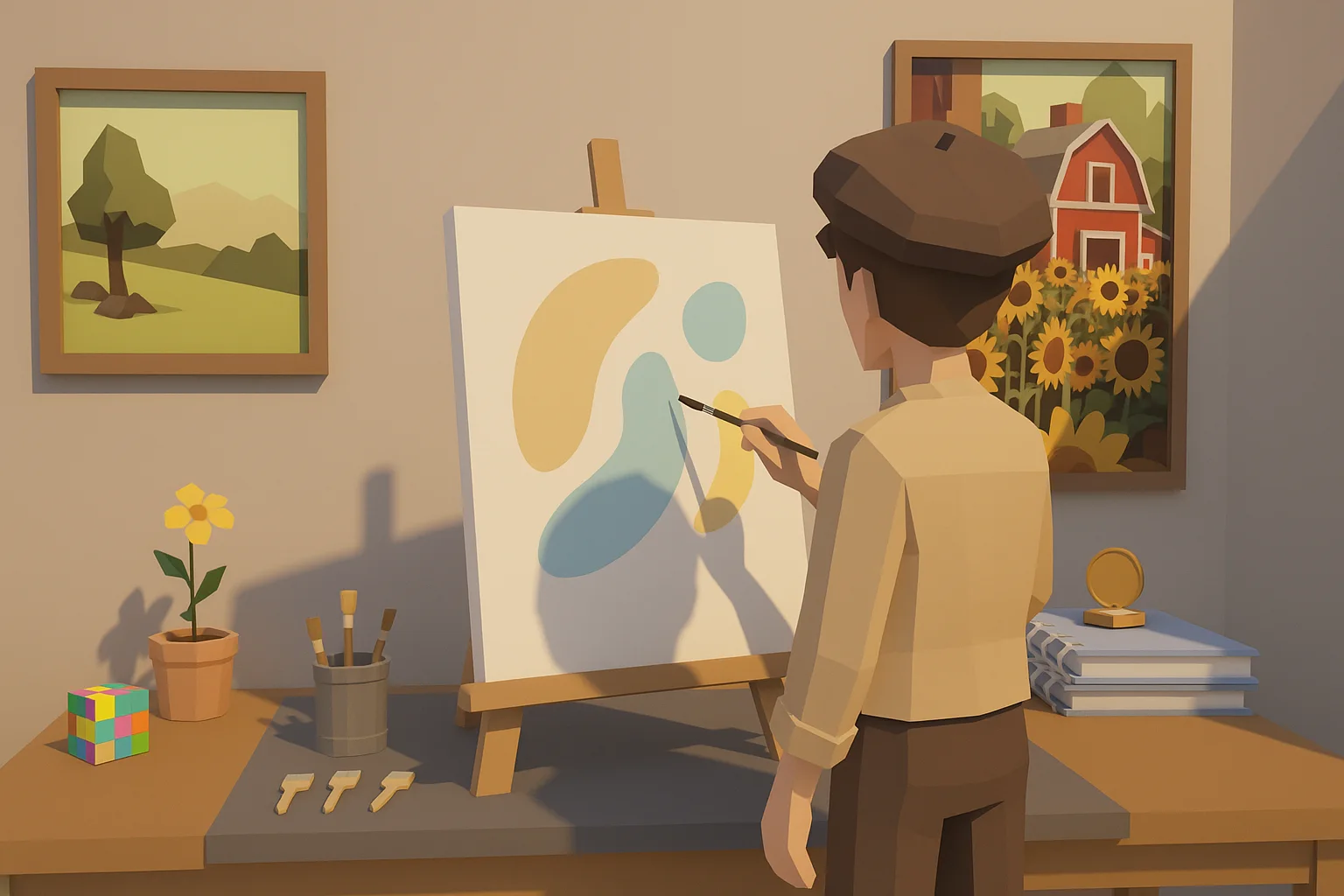
      The first technical milestone was deliberately plain: click, drag, and leave color on a canvas. A compact palette followed. A brush-size slider was replaced with the scroll wheel because it kept attention on the painting, while a troublesome brush preview was cut after a short experiment.

      • Direct render-texture painting
      • Color swatches that match the canvas
      • Scroll-wheel brush sizing
      A compact palette and scroll-wheel brush control keep the interaction immediate.
    5. 3 STAGES

      Scope through reuse

      Let one room carry an entire life

      Youth, adulthood, and old age reuse the same core room and painting interaction. Props, palettes, lighting, and the passing clock shift between stages, while each finished canvas is stored so the player’s work can return at the end.

      • Three stages of life
      • One reusable environment
      • Paintings saved across the full run
      One room changes through three stages of life instead of becoming three separate levels.
    6. FINAL STRETCH

      The emotional layer

      Function became a tiny story

      The first complete loop worked, but felt empty. Smoother transitions, changing light, a small music layer, ending text, and the sight of all three paintings together gave the short experience its weight. Fixing how canvases were indexed and restored made that final reveal coherent.

      • Mood changes between life stages
      • Music carries the sparse presentation
      • All three paintings return in the ending
    7. LAST PERSONAL HOUR

      The final scope pass

      Protect the game that already worked

      Plans for three to five endings, more varied rooms, sound effects, particles, post-processing, and extra polish were dropped. The shipped game kept two endings and one stable start-to-finish loop rather than risking the build for features that had not yet proved themselves.

      • Two endings instead of three to five
      • No last-minute feature experiments
      • Stability took priority over variety
    8. 05:01:00

      The upload

      Submitted with 5h 01m remaining

      A stable build, a short description, and a handful of screenshots reached the jam page five hours and one minute before the official deadline. Rough around the edges, but complete: a player could paint through all three life stages and see the experience resolve.

      • Playable from start to finish
      • Uploaded before the deadline
      • A finished small game, not a larger unfinished idea
    9. AFTER

      When the clock stopped

      The constraint became the lesson

      Painter’s Legacy showed that a single completed idea can carry more meaning than a long list of half-built systems. The result placed #55 overall and #21 for art among 431 entries—evidence that focus, atmosphere, and a clear interpretation could travel beyond the weekend.

      • #55 overall
      • #21 in art
      • 11 community ratings
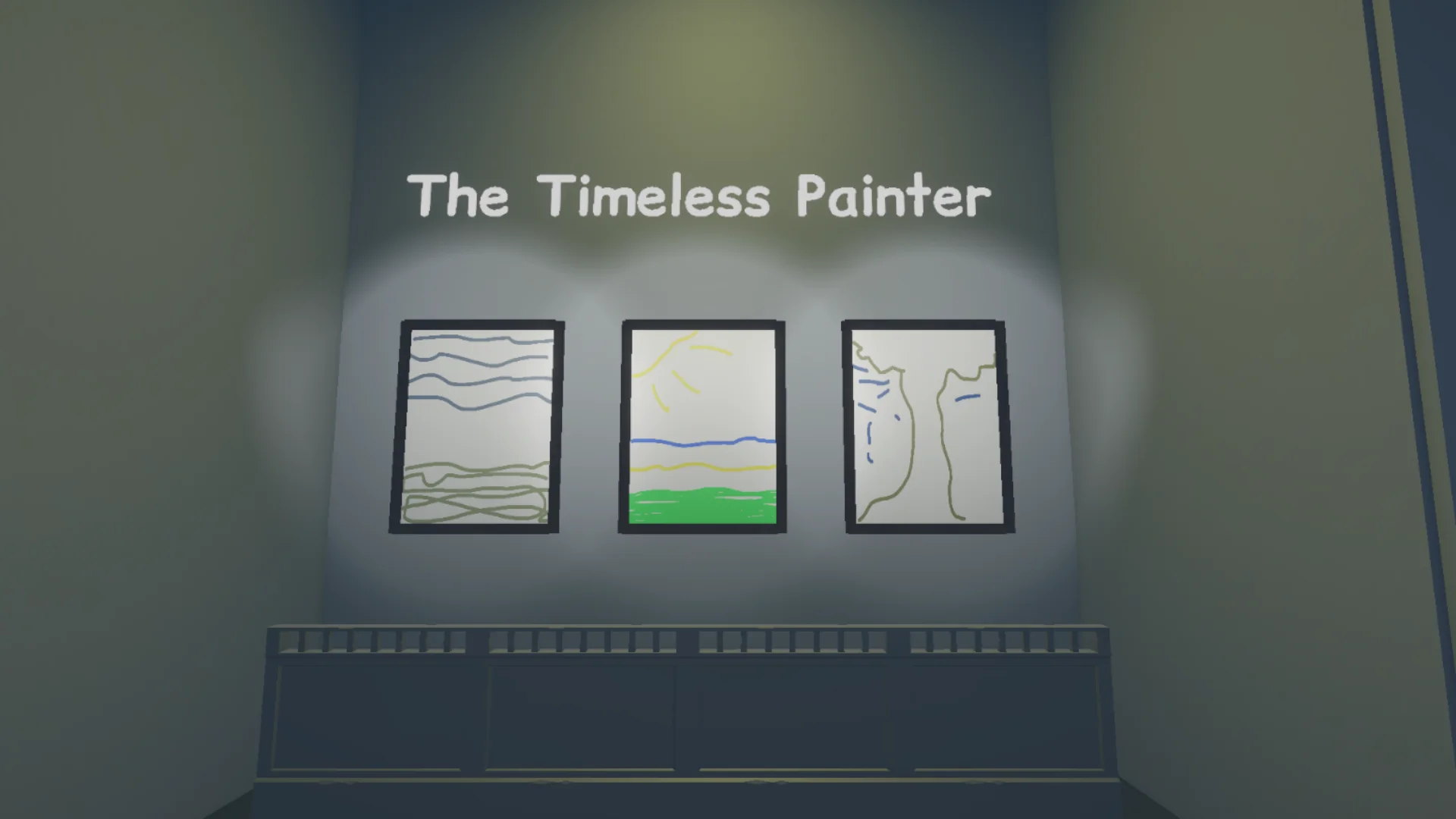
      The museum ending reframes the three saved canvases as a remembered body of work.

    The finished experience

    One interaction, three stages, two possible endings

    Painter’s Legacy stays intentionally small. Its systems all serve one arc: make something, watch time pass, and meet the work again after the painter’s life has moved on.

    Interaction

    Paint directly on the canvas

    Click-and-drag painting, a restrained palette, and scroll-wheel brush sizing keep the interface close to the creative act.

    Structure

    Repeat the mechanic, change the meaning

    The same interaction returns in youth, adulthood, and old age, gaining context as the room, colors, and available time shift.

    Continuity

    Carry every canvas forward

    Each painting is stored between stages and displayed again at the end, turning three short interactions into one connected life.

    Atmosphere

    Use mood where scope cannot add content

    Lighting, transitions, music, and a quiet final space create emotional contrast without multiplying environments or systems.

    The itch.io release discloses AI-assisted graphics. Game design, programming, implementation, art direction, and delivery were completed solo.

    The museum ending reframes the three saved canvases as a remembered body of work.

    Two frames for the same work

    Remembered or forgotten—by chance

    At the end of a run, the game randomly selects either the museum or the basement. Both show the paintings made across the three life stages; the setting changes how their legacy feels.

    Ending one

    The museum

    The three paintings hang together in a quiet exhibition beneath the title “The Timeless Painter.”

    Ending two

    The basement

    The same body of work waits in a darker, forgotten space, changing the emotional frame without changing what the player painted.

    The ending is random. It is not a score, an art-quality judgment, or a hidden evaluation of the player’s paintings.

    Scenes from the build

    A life told through three canvases

    The warm room, limited palettes, visible countdown, and final gallery make a modest production feel like one continuous memory.

    Watch the making-of

    After the deadline

    A modest game that found its audience

    The final submission was rated by 11 jam participants and finished #55 overall and #21 in art among 431 entries. More important than the ranking, it proved that a constrained, solo build could still land a clear emotional idea.

    Overall

    #55

    among 431 jam entries

    Art

    #21

    category placement

    Ratings

    11

    community jam ratings

    Team

    Solo

    design, code, art direction, and delivery

    Community response

    Players noticed the feeling first

    Jam comments repeatedly described the game as relaxing, cozy, and beautiful, and specifically praised the transition between life stages. The clearest improvement request was more control over when each painting is finished.

    01

    A small finished idea can be enough

    The game did not need a simulated art career. Painting three times, preserving the results, and changing their final context formed a complete arc.

    02

    Reuse can reinforce the theme

    Returning to the same room and interaction makes the passage of time legible while keeping production within reach.

    03

    Polish follows the emotional bottleneck

    Once the mechanics worked, transitions, lighting, music, and the final display added more value than another feature would have.

    04

    A deadline makes priorities visible

    Cutting unproven ideas in the final hour protected a stable, coherent game that could actually be shared and rated.

    The final brushstroke

    Choose what matters. Finish it.

    Painter’s Legacy is a tiny game, but that is the point. Under a deadline that left no room to hide behind future polish, one clear idea became a complete experience.

    Elmer Almer Ershagen© 2026